
Plateaus.
The Bane of My Existence.
Okay, that my be a bit melodramatic, but they do drive me nuts. I’ve done some reading and some experimenting the past few weeks, and asked every health care/fitness type person I know for advice. Here’s what I’ve learned about busting off a plateau.
There are three areas to focus on for your breakout: Food, Exercise and Attitude.
DISCLAIMER!!! Food intake and exercise routines are best coordinated with your doctor or nutritionist! Check with professionals before you plunge in!
Food
Eat Right – if you aren’t tracking your food intake, do so for a week. A slice of bread here, a handful of tortilla chips there – it all adds up. Seemingly benign snacks still count. Keeping a food diary is an honest look into what you are actually eating, not what you think you’re eating. So for one week, write down everything that you eat. Everything. From the sugar packet you dropped into your coffee to the two bites of chocolate ice cream you snuck from the offsprings’ bowl, to the handful of goldfish crackers – write it down. A food diary is an honest look into what you’re actually eating, not what you think you are eating.
Eat Smarter – Cut those refined carbs out of your diet. Think of refined carbs as ‘white food’ – pasta, rice, bread, potatoes, cake, cookies, donuts – anything made with white flour or white sugar. Substitute whole grains, veggies and fruits.
Eat Balanced – There is no magic number of carbs, protein and fat you need to eat in order to lose weight. However, a good place to start is:
- 50% of the calories you eat should come from complex carbs and…
- 30% of the calories you eat should come from lean protein and…
- 20% of the calories you eat should come from healthy fats.
Complex carbs are full grain, high fiber type carbs, such as those you find in whole grain pastas, breads, lentils and beans. Lean protein can be found in chicken, fish, turkey and very closely trimmed beef. Healthy fats? Is there such a thing? Yes!! Healthy fat refers to vegetable based oils, such as olive or canola, and yes, you need it in your diet! You wouldn’t think of driving a car without oil, right? Your body is a machine and needs lubrication, too. Healthy oils provide it.
Need a calculator to figure out how to get these percentages in? Here’s one online.
Eat More – Get off your very low-calorie diet. Your metabolism may slow down if you have severely reduced your daily calorie intake. Your body needs fuel to operate! Even if you sat on your tush and did absolutely nothing, your body needs a certain number of calories just to keep your heart beating and your brain functioning. Starving yourself is not an effective weight loss tool.
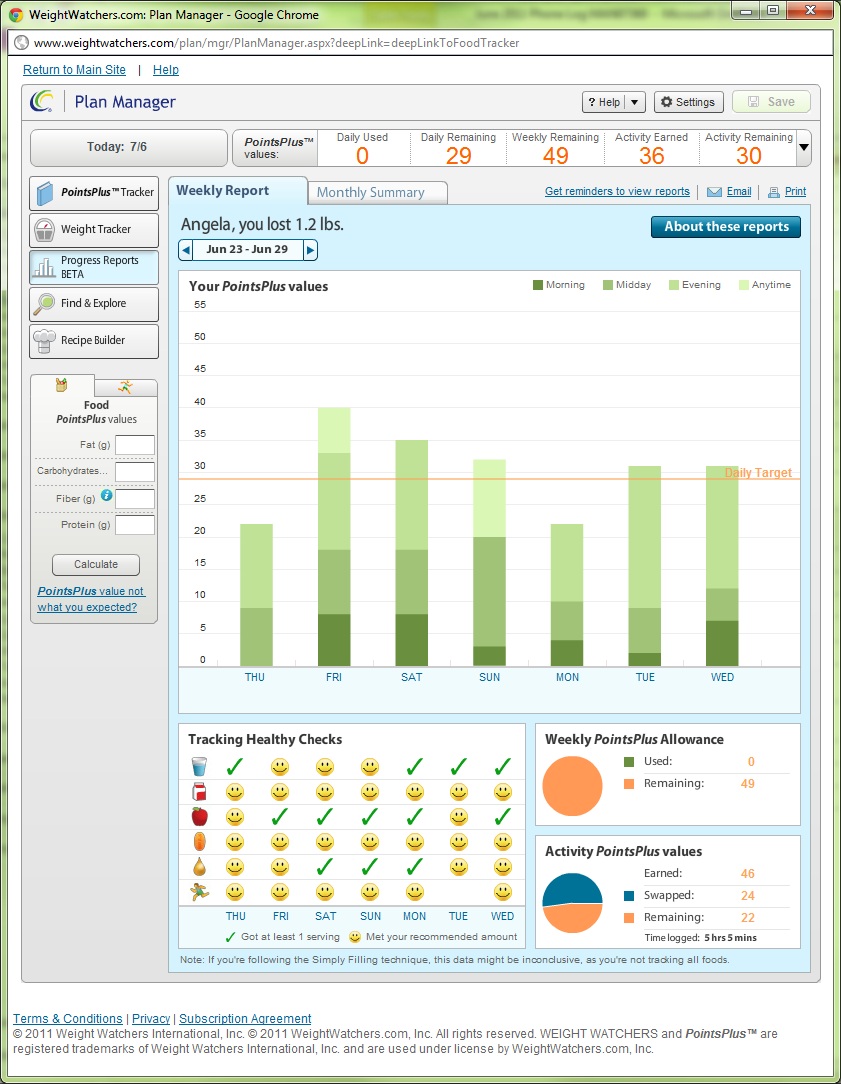
THIS was my “Ah-Ha” moment of the week. Several folks told me I wasn’t eating enough every day to support the amount of exercise I am putting in. It seems so counter intuitive to eat more in order to shed pounds. I took a leap of faith and ate more this week. I lost a pound. It may be a fluke – we’ll see on next week’s weigh in.
Exercise
Work Out Harder – walk a little faster, pedal a little faster, run up the hills instead of down.
Work Out Unpredictably – Over time, your body gets used to the same exercise. It’s called ‘muscle memory’. (Don’t believe me? Ask a piano teacher about muscle memory.) Your muscles get used to a specific routine and go into super-efficient autopilot mode when you do the same repetitive routines over and over. Been using the treadmill? Hop on the elliptical instead. Bike a different trail, add hill climbing. Tired of running? Try swimming, or Zumba. Play basketball with your kids. Accidentally let the dog off the leash and then chase it down the street. Keep it fun, keep it varied!
Work Out Longer – If you’ve been walking 30 minutes a day and have stopped losing weight, it may be time to step it up and start walking 45 minutes a day. I’ve upped my exercise from an hour to an hour and a half.
Work Out More Often – So you don’t really want to up the intensity or duration? Then work out more often. Add an extra day [or two!] to your workout schedule. Work out twice a day instead of once. That hour and a half? I get an hour during lunch, and added a thirty minute bike ride in the evening.
Attitude
This one is hard, I know. It’s hard to keep a good attitude when all you want to do is scream, kick your heels and throw shoes across the room. Patience is the key.
“Patience is waiting. Not passively waiting. That is laziness. But to keep going when the going is hard and slow – that is patience.” ~Unknown~
We didn’t become overweight overnight, and we won’t get back to healthy overnight, either. When you’re sitting to the far right on the weight number line, it is very easy to shed the pounds. Your body wants to be in balance and quickly tries to get there. As you get closer and closer to your goal weight, just resign yourself to the fact that it will take more time to lose that last 10 pounds. Be Patient! Be Persistent! While you wait, remind yourself of all you’ve accomplished and how far you’ve come.
Take a look in the mirror. Do you look better? Are your clothes fitting better?
If you gained weight but look the same, you’re gaining muscle mass! (That’s me!! Gaining weight, and not just looking the same, but shrinking more! My clothes are literally sliding off my body. Why am I so obsessed with the number on the scale?)
Do the math and keep track. Check your body fat percentage – if it’s going down, then you’re getting healthier! Here are the directions for calculating your body fat percentage.
Focus on how strong you are becoming and how healthy you feel instead of that number on the scale. It’s just a number. Hear that, Self?
JUST A NUMBER!!
It doesn’t tell anyone about how amazing you are, how smart, how creative, how funny. It doesn’t dictate who your friends are or whether or not your spouse and offspring love you to pieces. YOU are uniquely you, ‘fearfully and wonderfully made’ (Psalms 139:14) and that number will eventually get down to a range you can live with.



 Keeping the Faith
You must be logged in to post a comment.